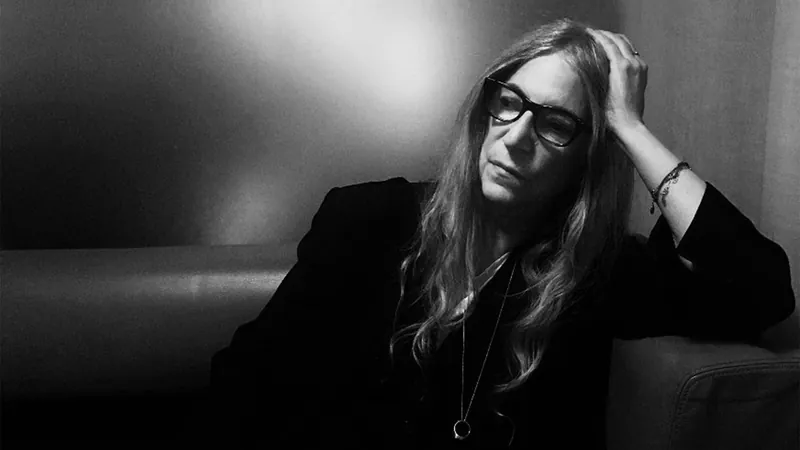
The most music-heavy room at this year’s Venice Biennale belongs to the Vatican. The Holy See’s pavilion, titled The Ear Is the Eye of the Soul, is a sound show: new works by FKA twigs, Brian Eno, Patti Smith, Jim Jarmusch, Devonté Hynes, Meredith Monk, Terry Riley, Holly Herndon and Mat Dryhurst, Moor Mother and more, heard on headphones while you walk a walled convent garden.
The Holy See Press Office presented the pavilion on Monday (April 27), after the lineup of 24 artists, musicians, poets, architects and filmmakers was announced two weeks earlier. It is curated by Hans Ulrich Obrist and Ben Vickers with the Soundwalk Collective, and it opens with the Biennale on May 9 and runs through Nov. 22.
A sonic prayer for a 12th-century nun
Its patron is Saint Hildegard of Bingen, the Benedictine abbess, poet, healer and composer who lived from 1098 to 1179. The project statement calls the show “a sonic prayer,” and the commissions answer her chants, writings and visionary images through voice, instruments and, at times, silence.
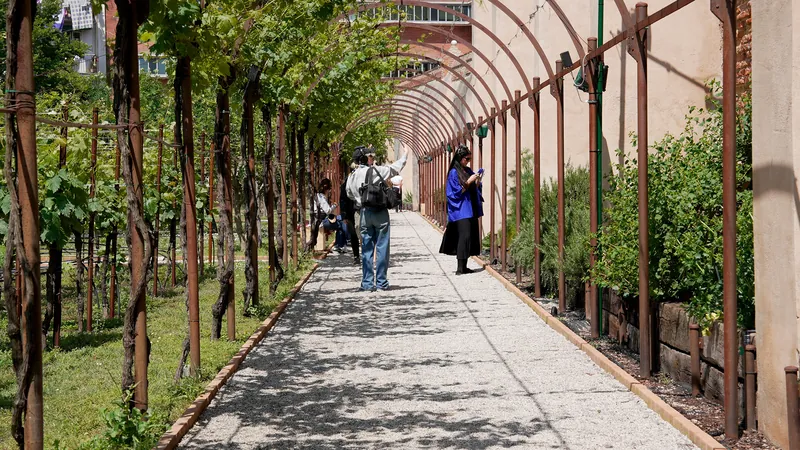
The first venue is the Mystical Garden of the Discalced Carmelites in Cannaregio, a 17th-century convent garden usually closed to the public. Soundwalk Collective built a site-specific device that picks up the garden’s own sounds in real time. The second, the Complesso di Santa Maria Ausiliatrice in Castello, is staged as a contemporary scriptorium. It holds a living archive of Hildegard texts, a monastery design by Tatiana Bilbao Estudio and the last work of the German filmmaker Alexander Kluge, who died on March 25 at 94: a 12-station film and image installation spread across three rooms.
Why it matters
The pavilion is a direct reply to the Biennale’s own theme. The Biennale’s late curator, Koyo Kouoh, asked visitors to slow down for In Minor Keys, and the Holy See says its show was conceived in response to that call. Obrist put Hildegard’s logic in one line at the press conference.
For Saint Hildegard, sound was a form of knowledge. Music becomes a link between the self and the world, between the microcosm and the macrocosm,
Hans Ulrich Obrist, curator, Vatican News
The pavilion also carries a message about technology. The press release quotes Pope Leo XIV: “The logic of algorithms tends to repeat what ‘works,’ but art opens up what is possible. Not everything has to be immediate or predictable.” Cardinal José Tolentino de Mendonça, who is commissioner of the pavilion, told the press conference that artists should be heard the way prophets are: “We need artists to speak.”
It follows the Holy See’s 2024 pavilion, in which Maurizio Cattelan worked with inmates at the Giudecca Women’s Prison. This time the Vatican has picked musicians, and a few of them are about as far from church music as it gets. For the full opening, see our Venice report.
- Title
- The Ear Is the Eye of the Soul
- Curators
- Hans Ulrich Obrist and Ben Vickers, with Soundwalk Collective
- Venues
- Mystical Garden of the Discalced Carmelites (Cannaregio); Complesso di Santa Maria Ausiliatrice (Castello)
- Dates
- May 9 to Nov. 22, 2026
Added to the High Grailed archive on October 12, 2026.