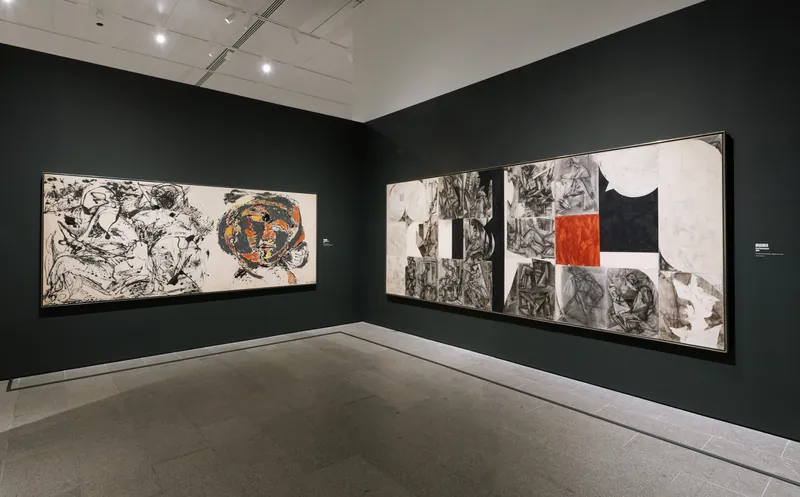
Jackson Pollock’s drip paintings are so famous that they have “become like wallpaper,” says the Met’s David Breslin. So the museum hung them at different angles and played with reflective surfaces to make you look again, The Art Newspaper reports. That’s the sharpest move in Krasner and Pollock: Past Continuous, which opened Oct. 4.
The show spans more than 120 paintings, works on paper and ephemera, some from private collections and rarely seen. It’s the first to set the artists’ full careers side by side, not just the Long Island years from 1942 to 1956, and Cultured calls it the first major New York show for either artist in two decades. Breslin curated with Brinda Kumar.
Read moreRoy Lichtenstein’s Whitney Retrospective Says He Saw the Repost Coming
The argument is about fairness to Lee Krasner, who spent decades in her husband’s shadow.
She had a smaller studio space. He had the whole barn.
David Breslin, curator, The Art Newspaper
After Pollock died in a car crash in 1956, she took over the barn and made some of her biggest work. “Krasner survived Pollock by many decades, and that was probably her most productive time,” Kumar says. The title comes from a 1976 Krasner painting that folds in a collage of her own earlier drawings, and the show is bookended by collages, which Breslin treats as a metaphor for the couple: two materials that become something new once they sit side by side.
The curators also credit what Breslin calls Krasner’s “unseen labour”: “Krasner stewarded Pollock’s posthumous market.”
Four critics, one bar
Cultured sat four writers down at Julius’, the West Village bar, on Sept. 30, to argue about it. Jarrett Earnest said he had expected a mistake.
When I heard about this show, I thought it was a really bad idea, that it was going to make them both look bad. And I’m shocked that, actually, it made them both look incredible.
Jarrett Earnest, critic, Cultured
Julia Bryan-Wilson was skeptical too, and she pointed to how Krasner was treated while she was alive: the paintings were called “feminine” and “quietly innocuous,” she said, and the pair’s first show together, in 1949, was titled “Artists: Man and Wife.” “That says it all,” she said. For Earnest, the show’s answer is to refuse the split: “Basically, without Krasner, we don’t have Pollock. This is the argument. You cannot separate them.”
They didn’t agree on everything, and the loudest disagreement was about furniture. Krasner’s 1947 mosaic coffee table, which she designed and Pollock helped build, is in the show.
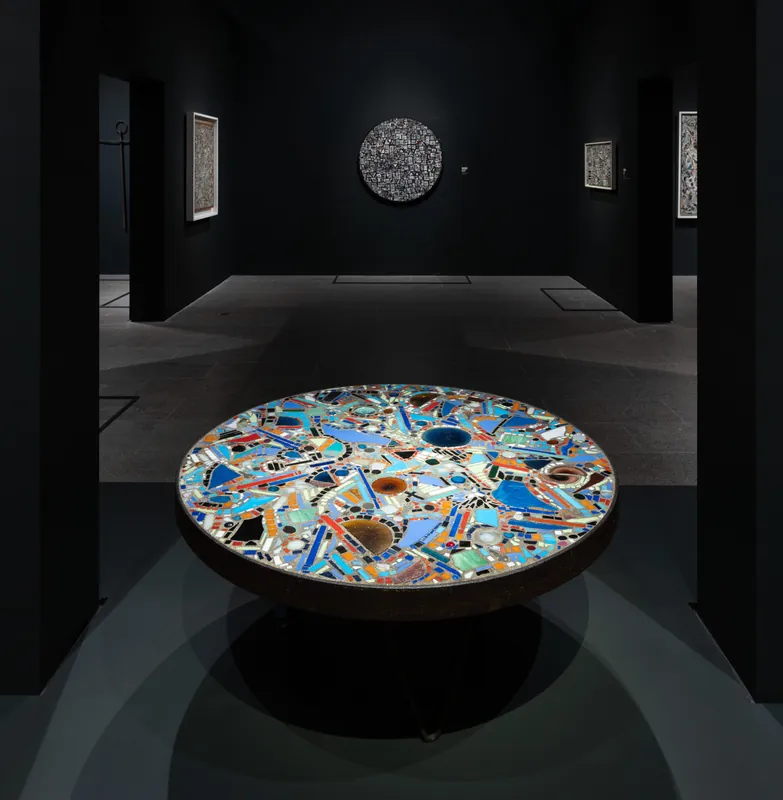
It’s horrible. Hideous.
David Rimanelli, critic, on the mosaic table, Cultured
Bryan-Wilson loved it: “And the fact that they both worked on it.” Earnest liked seeing it beside Pollock’s Full Fathom Five, where actual junk is embedded in the paint.
Breslin’s own hope is bigger than a reassessment. “I hope the show undoes this idea that a great artist is a lonely person,” he says. Krasner and Pollock: Past Continuous runs at the Metropolitan Museum of Art in New York through Jan. 31, 2027.
- Where
- The Metropolitan Museum of Art, New York
- Dates
- Oct. 4, 2026–Jan. 31, 2027
- Curators
- David Breslin and Brinda Kumar
- Works
- More than 120 paintings, works on paper and ephemera